
 |
|
|
• Architecture |

|
|
|
Reflections and Insights
|
|
| ACCESSORY DWELLING UNITS Articles |
|
| California ADU Law Updates Effective January 1, 2026 | |
| California Assembly Bill 2533 | |
| What's Changing for ADUs in 2026? | |
| You Too Can Have an ADU | |
| ADUs in Santa Cruz County: Current Regulations | |
| Also | |
| Reflections and Insights: Implementing the Principles of the Not So Big House | |
California ADU Law Updates Effective January 1, 2026
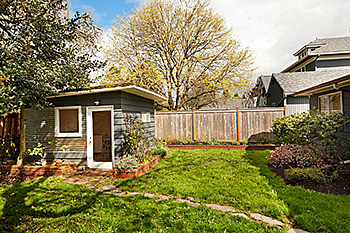 Detached backyard ADU (image: Getty Images)
Clarification of “Interior Livable Space” (SB 543)
SB 543 amends multiple Government Code sections to specify that statutory square footage references for ADUs and JADUs mean interior livable space. The clarification applies to:
• The 500-square-foot maximum size for a JADU
• The requirement that local ordinances not preclude at least 800 square feet of interior space for an ADU
• Maximum size protections of 850 square feet (one-bedroom) and 1,000 square feet (two or more bedrooms)
By defining square footage as interior livable space, the statute standardizes measurement methodology statewide.
Ministerial Review Timelines (SB 543)
SB 543 supplements the existing 60-day approval or denial requirement for complete ADU and JADU applications by establishing additional procedural deadlines. Local agencies must now:
• Determine whether an application is complete within 15 business days of submission.
• If incomplete, provide written notice specifying missing materials and how to correct them.
• Review resubmitted applications for completeness within 15 business days.
• Provide a written appeal process for incompleteness determinations or denials.
• Issue a final written determination on an appeal within 60 business days.
These requirements apply regardless of whether a jurisdiction has adopted a local ADU or JADU ordinance. JADU applications must be processed ministerially under state law even if no local JADU ordinance exists.
Combinations of ADUs on a Single Lot (SB 543)
SB 543 clarifies that statutory ADU categories under Government Code section 66323 may be combined. On a lot with a single-family dwelling, the following may be approved ministerially if statutory standards are met:
• One detached ADU
• One converted ADU (attached or internal)
• One JADU
On multifamily lots, converted ADUs and detached ADUs may also be combined pursuant to statutory limits. This amendment codifies prior interpretive guidance from the California Department of Housing and Community Development.
Fee Limitations and School Impact Fees (SB 543)
• SB 543 clarifies the application of development impact fees and school fees as follows:
• ADUs of 750 square feet or less of interior livable space remain exempt from development impact fees.
• JADUs of 500 square feet of interior livable space are included within impact fee protections.
• ADUs and JADUs of 500 square feet or less are exempt from school impact fees.
For larger ADUs, impact fees must be proportional to the square footage of the primary dwelling. These fee-related provisions took effect October 10, 2025.
Fire Sprinklers and Objective Standards (SB 543)
The amendments confirm that fire sprinklers may not be required in ADUs or JADUs if they are not required in the primary dwelling. SB 543 also reinforces that local agencies may not impose objective standards that conflict with statutory ADU entitlements.
HCD Review and Ordinance Compliance (SB 543 and SB 9)
Under SB 543 and SB 9 local agencies must submit both ADU and JADU ordinances to the California Department of Housing and Community Development (HCD) within 60 days of adoption. If an ordinance is not submitted within that timeframe, it is null and void. If HCD finds that an ordinance does not comply with state law and the local agency fails to respond within 30 days, the ordinance becomes null and void. In such cases, state ADU law governs directly.
JADU Owner-Occupancy and Rental Terms (AB 1154)
AB 1154 modifies owner-occupancy requirements for JADUs. Owner occupancy may not be required if the JADU has independent sanitation facilities (its own bathroom). If the JADU shares sanitation facilities with the primary dwelling, the owner-occupancy requirement may still apply. The bill also requires that JADUs be rented for terms longer than 30 days. JADUs may not be used as short-term rentals. This requirement applies statewide.
Coastal Development Permits and Disaster Recovery (AB 462)
AB 462 makes two primary changes affecting ADUs in coastal and disaster-affected areas.
Coastal Development Permits
Coastal Development Permit (CDP) applications for ADUs must now be approved or denied within 60 days of receipt of a complete application. The bill also:
• Requires concurrent processing of CDPs and local planning permits
• Eliminates appeals of ADU CDPs to the Coastal Commission
• Applies a 60-day review timeline to Coastal Commission review in areas without a certified Local Coastal Program
• Provides that failure to act within 60 days results in deemed approval
Disaster-Affected Counties
AB 462 permits issuance of a Certificate of Occupancy for a detached ADU before issuance for the primary dwelling if:
• The Governor declared a state of emergency for the county on or after February 1, 2025;
• The primary dwelling was substantially damaged or destroyed by the declared event; and
• The ADU has received construction permits and passed all required inspections.
• This provision is limited to qualifying disaster circumstances.
Conclusion
The 2026 amendments to California’s ADU statutes focus on clarification, procedural requirements, and enforcement. They standardize measurement definitions, establish defined completeness review timelines, expand fee protections for small units, adjust JADU occupancy rules, streamline coastal permitting timelines, and strengthen state oversight of local ordinances. The statutory framework governing ADUs and JADUs remains ministerial and statewide in application, with local ordinances required to conform to state law.
For Further Reading:
• The State’s legislative digest and text of SB543 found at: https://leginfo.legislature.ca.gov/faces/billNavClient.xhtml?bill_id=202520260SB543
• Senate Bill 543, Senate Bill 9, Assembly Bill 462, and Assembly Bill 1154 are discussed further in the article found at: https://www.bwslaw.com/insights/public-law-update-2025-adu-legislative-update/
• The article, “Governor Newsom Signs Four New Accessory Dwelling Unit Bills”, can be read at: https://bbklaw.com/resources/la-110725-governor-newsom-signs-four-new-accessory-dwelling-unit-bills
READ MORE FROM DANIEL SILVERNAIL ARCHITECT
501 Mission Street, Suite #2, Santa Cruz, CA 95060 • tel 831-462-9138 •
©2026
Our mission is to be your resource for • innovative • environmentally responsible • architectural design solutions