
 |
|
|
• Architecture |

|
|
|
Reflections and Insights
|
|
| ACCESSORY DWELLING UNITS Articles |
|
| California ADU Law Updates Effective January 1, 2026 | |
| California Assembly Bill 2533 | |
| What's Changing for ADUs in 2026? | |
| You Too Can Have an ADU | |
| ADUs in Santa Cruz County: Current Regulations | |
| Also | |
| Reflections and Insights: Implementing the Principles of the Not So Big House | |
What’s Changing for ADUs in 2026?
A Guide to California’s New Laws
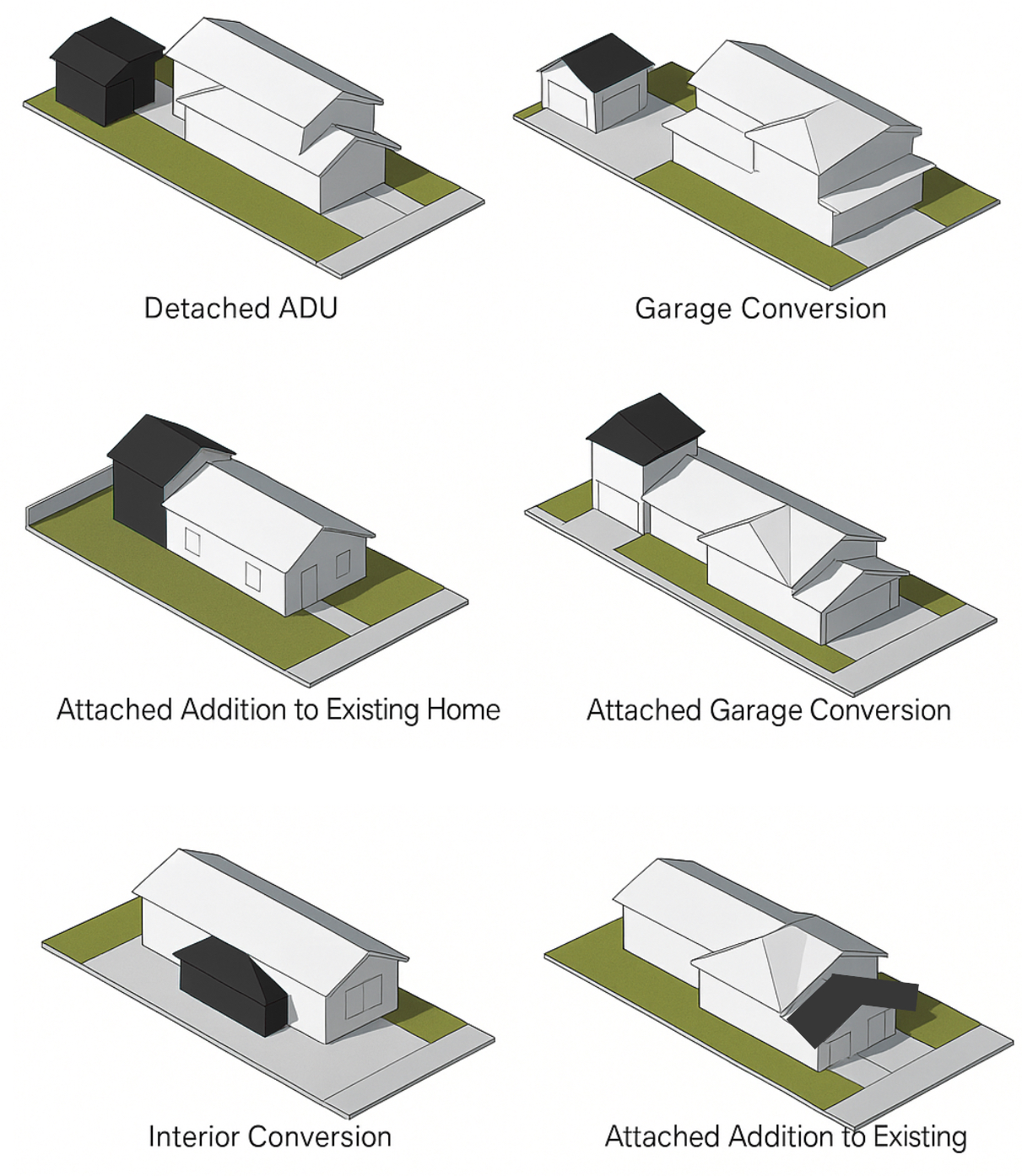 Some types of ADUs (credit: City of McFarland, CA)
Click on image to view in new window.
In 2025, the Legislature continued this trend. Governor Newsom signed four new ADU-related bills: AB 462, AB 1154, SB 9, and SB 543. One (AB 462) took effect immediately in October 2025; the rest take effect on January 1, 2026. Most of these changes are clarifications rather than dramatic policy shifts, but they will affect how cities process ADUs—and how homeowners and architects should plan their projects. Perhaps most importantly, local ADU ordinances must be updated promptly, or they risk becoming null and void.
Below is a plain-language guide to what’s changing and why it matters.
1. Faster ADU Approvals in the Coastal Zone (AB 462)
ADUs in the Coastal Zone have historically faced slower processing due to the need for a coastal development permit (CDP). Before 2026, the CDP process was not subject to the 60-day state ADU approval timeline, and in many coastal areas, CDPs could be appealed to the California Coastal Commission, adding months or even years. AB 462 changes this landscape significantly.
Key Changes:
• 60-Day Clock for CDPs: Cities with a certified local coastal program must now approve or deny a CDP for an ADU within 60 days, matching the state’s ADU timeline.
• No More Appeals to the Coastal Commission: CDPs for ADUs can no longer be appealed to the Coastal Commission. This is a major streamlining that will help homeowners in coastal communities move forward faster.
• For Cities Without a Certified LCP: They must notify the Coastal Commission immediately when an ADU application is submitted, and in most cases, the Commission must also act within 60 days.
Why This Matters:
For coastal homeowners—from Santa Cruz to Malibu—these changes eliminate a significant source of delay. ADUs in the coastal zone should now move through permitting more predictably and with less risk of appeal-related delays.
2. Earlier Certificates of Occupancy in Disaster Areas (AB 462)
AB 462 also creates a narrow exception allowing a detached ADU to receive a certificate of occupancy (CofO) before the main home, but only in disaster zones.
Conditions:
All three must be true:
1. A state of emergency was declared in the county on or after Feb 1, 2025.
2. The primary dwelling was damaged or destroyed in that event.
3. The ADU has passed all required inspections.
Why This Matters:
For homeowners rebuilding after fires or floods, this allows an ADU to serve as temporary housing while the primary residence is under reconstruction.
3. Changes to JADU Owner-Occupancy and Short-Term Rentals (AB 1154)
A JADU is a small unit (up to 500 sq. ft.) carved out of the existing home. Historically, homeowners were required to live on the property if they created a JADU. AB 1154 relaxes this rule—but only in certain cases.
Key Changes:
• Owner-Occupancy Now Required Only When the JADU Shares a Bathroom. If the JADU has its own bathroom, the owner is not required to live on site.
• Short-Term Rentals Are Banned for JADUs: All JADUs must be rented for terms longer than 30 days. Many ADUs are already subject to similar rules, depending on how they were created.
Why This Matters:
For many homeowners, adding a bathroom to a JADU not only improves livability but also eliminates the owner-occupancy restriction, increasing flexibility for renting or future resale.
4. Cities Must Submit Their ADU Ordinances to HCD or Lose Them (SB 9 & SB 543)
This is one of the most consequential changes—but it affects cities more than individual homeowners. It does, however, indirectly impact your project.
Key Changes:
• Cities must send their ADU ordinances to the California Department of Housing and Community Development (HCD) within 60 days of adoption.
• If they fail to do so, the ordinance becomes null and void.
• If HCD finds a local ordinance noncompliant and the city doesn’t respond within 30 days, the ordinance is also void.
Why This Matters:
If a city’s ADU ordinance becomes void, it must default to state standards, which are often more permissive than local rules. For homeowners, this can be advantageous—but it also can cause temporary confusion until the city adopts a corrected ordinance.
4. 5. Clarifying ADU and JADU Size, Fees, and How Many Units You Can Build (SB 543)
SB 543 is a broad cleanup bill with several practical implications.
A. “Interior Livable Space” Defined:
Until now, there was ambiguity about whether ADU/JADU size limits referred to interior area or exterior building footprint. Key Change:
• All size limits now refer to interior livable square footage.
Why This Matters:
Design calculations become simpler and more predictable, especially for conversions and tight sites.
B. Certain ADUs and JADUs Are Fully Exempt from Impact Fees
Impact Fee Rules:
• ADUs 750 sq. ft. or smaller (interior livable space) are exempt from development impact fees.
• ADUs 500 sq. ft. or smaller are exempt from school fees.
• JADUs (max 500 sq. ft.) are fully exempt from both.
Why This Matters:
For many homeowners, keeping an ADU at or below 750 sq. ft. can save many thousands of dollars in fees.
C. You Can Combine ADU Types on a Single Lot
One of the most useful clarifications in SB 543 resolves a long-standing question: Can you combine different ADU types allowed under the law? Answer: Yes.
Allowed Combinations on a single-family lot:
• One detached ADU
• One converted ADU (usually garage or interior conversion)
• One JADU
Allowed Combinations on a multifamily lot:
• Multiple converted ADUs (within existing building)
• Up to two detached ADUs
Why This Matters:
For homeowners, this clarifies what’s possible. For designers and architects, it confirms that thoughtful site planning and creative re-use of existing spaces can yield multiple units legally.
D. New Application Timelines for Cities (and More Certainty for Homeowners)
For years, state law required cities to approve or deny ADU applications within 60 days of receiving a complete application. But cities often delayed the process by taking weeks to decide whether the application was complete. SB 543 closes that gap. New requirements:
Cities must:
1. Decide if an ADU application is complete within 15 business days.
2. If incomplete, provide a detailed list of missing items.
3. Review each resubmittal within another 15 business days.
4. Offer a written appeal process if an applicant disagrees with a completeness finding or a denial.
5. Issue a final written appeal decision within 60 business days.
Why This Matters:
This greatly reduces uncertainty and the ability for jurisdictions to stall projects during intake. Homeowners, builders, and architects will have clearer timelines and faster feedback.
Bottom Line: What Homeowners, Architects, and Builders Should Know
These new laws are largely aimed at:
• speeding up approvals,
• reducing fees,
• clarifying how many ADUs are allowed,
• increasing flexibility for JADUs,
• and keeping cities accountable to state requirements.
The most impactful changes for homeowners are:
• Much faster approvals in the Coastal Zone
• Ability to combine JADUs, converted ADUs, and detached ADUs
• Clearer size definitions and broader fee exemptions
• More predictable permitting timelines
For architects and builders, these changes provide more certainty when advising clients and preparing site strategies.
READ MORE FROM DANIEL SILVERNAIL ARCHITECT
501 Mission Street, Suite #2, Santa Cruz, CA 95060 • tel 831-462-9138 •
©2026
Our mission is to be your resource for • innovative • environmentally responsible • architectural design solutions